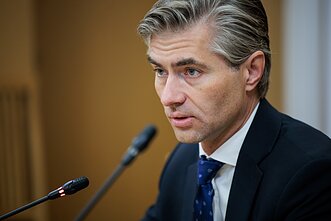















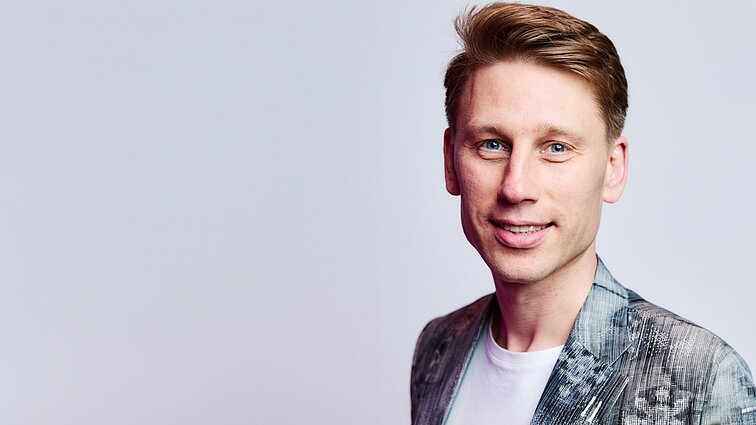
Artificial intelligence is no longer merely a science-fiction scenario – it is reshaping how we work, how we create, and how we understand human potential. Paulius Jurcys, an intellectual property law expert and AI researcher who has spent the past decade in Silicon Valley building and studying AI twins, shares his insights.
In Silicon Valley, Jurcys found himself in an environment where some of the most consequential technological shifts were born.
“People come from all over the world, bringing their ideas and the ambition to build a product. It is an extraordinarily dynamic environment,” he said.
That same dynamism drove exceptionally high turnover of people. Before the pandemic, roughly a quarter of San Francisco’s population changed every year.
This reflected the competitive climate and the sheer pace of technological development: “People arrive, build a product, commercialise it, and move on.”
AI twins
Speaking about his path into artificial intelligence, Jurcys says his interest began when the field was still largely the stuff of science fiction.
“Even then, we were talking about algorithms, manipulation and data collection,” he said.
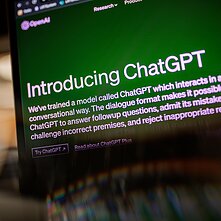
The turning point was ChatGPT – the moment AI became directly accessible to the general public. “Suddenly anyone could try the technology for themselves and test its capabilities and its limits.”
In his own daily life, he uses AI pragmatically.
“You need to understand the specifics of your own work and think about where you can save time and optimise processes. I try to work out which tool would help solve a particular problem,” said Jurcys.
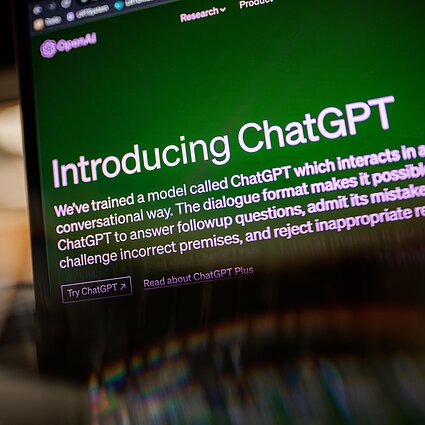
The integration of AI also raises demands for new concepts, including the integration of conversational systems like ChatGPT into digital representations of individual people – so-called AI twins.
The so-called AI twins are digital counterparts built from a person’s own data, knowledge, physical appearance and behavioural patterns.
Over time, such digital replicas can become increasingly sophisticated, Jurčys said.
“At first, it may only be a simulation of an individual’s knowledge in a particular field. But as more and more information about a person is gathered, the AI twin also develops and improves.”
Putting your AI twin to work
A few core needs consistently emerge when discussing AI twins in Silicon Valley.
“Every answer relates to some aspect of personal health or productivity at work. AI twins are seen as an opportunity to improve personal life,” Jurčys said.
AI could help analyse vast quantities of personal data – from physical activity to daily habits.
“If I could compile a daily matrix of health data from a smartwatch, for instance: heart rate, steps taken, information about nutrition. That data would help detect certain changes in the body earlier,” he said.
AI twins could also act as an intermediary between a person and those around them.
“In my case, it was obvious that I could leverage AI twin to open up my expertise to anyone who wanted it, first and foremost my law school students and colleagues at work. There is never enough time to answer every message and email,” Jurcys said.
Such tools could also be used for generating ideas or increase productivity.
“Sometimes we can use technology to break the ice and think about things we have not yet considered,” he said.
Jurcys emphasised that building an AI twin begins with collecting data about oneself like recording daily habits, notes, or health information.
These are the things the people have always done, like keeping diaries and recording memories. In the digital age, that process is simply taking a new form.
“We need to document our lives. That can mean daily notes or journals. And new possibilities are emerging: you can use sensor-powered trackers to capture more information about your daily routines, and even integrate your voice and your image,” he said.
The more context an AI has about a person, the more it can offer: from help with everyday tasks to the ability to anticipate certain trends.
“The question is how we will use that predictive capability for the benefit of each of us,” said Jurčys.
Crossing boundaries
Such technology could become a way of preserving memories of loved ones. But it also raises profound ethical questions.
“We do not make a person immortal; we simply make the data that has been collected interactive. In the past, we could leaf through a diary; now, with enough information, we could also simulate a conversation,” Jurcys said.
“This is where things could drift towards Black Mirror,” he added.
According to Jurcys, the most significant future changes may involve human memory, learning and our capacity to solve complex problems.
“We remember selectively, and we are inclined to forget a great deal. If we could preserve more, perhaps looking back at the past would be more interesting,” said Jurcys.
The risk of a digital divide
A great deal of science fiction no longer feels far removed from reality, Jurcys said.
“Many works of science fiction have shaped the thinking of the people building today’s technologies,” he added.
One idea now being actively debated is that technological development should be accelerated as much as possible.
“The question is how much we truly control the development of AI technologies, and whether we should constrain it. We are at an inflexion point: technology companies have already amassed enormous volumes of data. The question is where, in this ecosystem, there is still room for each of us,” said Jurcys.
Attitudes to AI development vary considerably across the world.
“In Europe, much effort is placed on trying to regulate and promote responsible use of AI, while in Silicon Valley it may seem that we drive straight ahead,” he said.
Even so, what matters most is finding a shared understanding of how these technologies should develop.
“The greatest threat is a vast divide between people who have digital tools and those who are left behind,” he said.
At the moment, people can master new technologies fairly quickly; but that may not last.
“Children, students and experts are more or less on the same level. Anyone willing to make a little effort could reach the expert level very quickly. But if we fail to do so, the gap widens extremely fast,” Jurcys said.
The privacy question
According to the AI expert, there is still no consensus on who owns a person’s data: the individual or the corporations that collect it.
“Although digital technology now has a 30-year history, we have still not agreed on who that data belongs to. Looking at it optimistically, perhaps we still have time to bend the curve and give people at least some ability to control their own data,” he said.
Today, the biggest battle is being fought over biometric data gathered by smartwatches, smart rings and other devices.
“We have the opportunity to build technologies in which data is processed not in corporate clouds but locally, on each of our own devices, so that the algorithm comes to the person, rather than the person going to the algorithm,” said Jurcys.
Such data, he noted, can reveal an enormous amount about a person, from their daily habits to discreet facts about their health.
“Every data point becomes important, because AI systems with more context about a person can take on ever more tasks,” he said.
In the age of AI, it is becoming harder to distinguish which data is personal. The boundary between public and private life was becoming even more blurred.
“With new technologies, that boundary may all but disappear. The question is whether we will manage to prevent the disappearance of privacy,” he said.
It’s important that people gain a better understanding of what data they are sharing and how much control they retain.
“My hope is that each of us will experiment with these tools and work out where the line is, what we are willing to give away, and what we are not. If each of us understood that, perhaps we could preserve more of our autonomy,” said Jurcys.
Who serves whom?
Asked about fears that artificial intelligence will replace human beings, Jurčys suggested reframing the question – not whether humans will become redundant, but who serves whom.
“In today’s data ecosystem, we have the concepts of the ‘data subject’ and the ‘data controller’. All the power sits with the data controller. The question is whether we can seize this historic opportunity to shift that balance of power and give people greater capability.”
At the same time, Jurcys stressed that withdrawing from technology altogether was not a solution either.
“We must protect and cultivate the human experience, but we cannot live entirely cut off, ignoring what is happening around us. If we read only the newspaper and never go online, we may well do ourselves a disservice and be left behind,” he said.
In future, he argued, the priority will be not to compete with artificial intelligence, but to understand how human abilities and technology can complement one another.
“We should not ignore either side. We need to assess the limits within which each of these skills and values can be applied,” Jurcys noted.
Asked whether people are ready for such a shift, he suggested one of the greatest challenges was simply accepting that artificial intelligence has already become part of everyday life.
“We can push these new forms of life away, or we can try to find new ways of relating to them, and a new social contract,” he said.

Newsletter
Every Friday morning.