












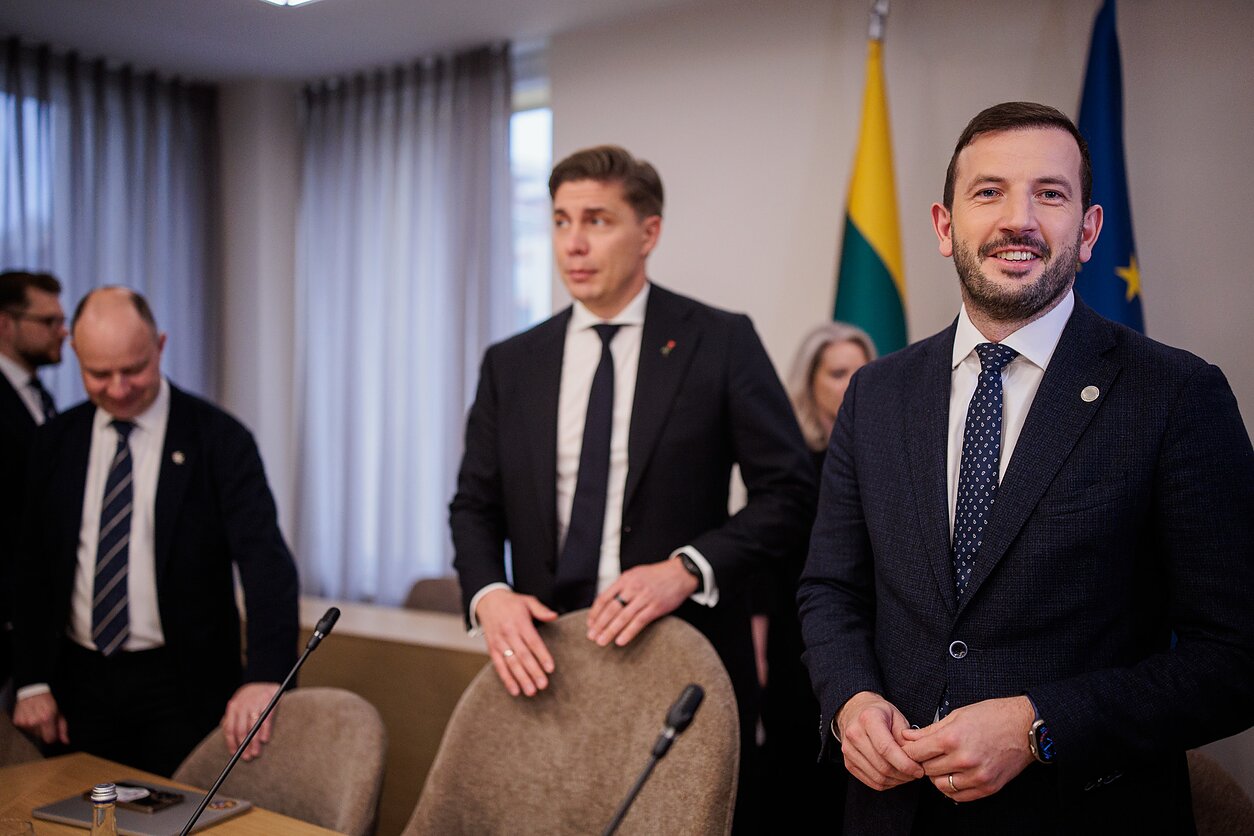
The leaders of three Lithuanian parliamentary groups are set to sign a coalition agreement on Thursday, paving the way for the formation of a new government - Lithuania's 21st since the restoration of independence in 1990.
Prime Minister Inga Ruginienė's government plans to resign on Tuesday June 23, her aide Ignas Algirdas Dobrovolskas confirmed.
Under Lithuanian law, the prime minister notifies the president of the government's resignation, which is first announced during a cabinet meeting. The president then has 15 days to submit a candidate for the new prime minister to parliament.
Social Democratic Party chairman Mindaugas Sinkevičius is expected to be nominated as the new prime minister. Once approved by parliament, he will have 15 days to present a new cabinet and government programme.
How the ministries will be divided
The Social Democrats, as the largest partner, will take nine of the fourteen ministries: Environment, Finance, Defence, Culture, Social Security and Labour, Transport, Education Science and Sport, Foreign Affairs, and Internal Affairs.
The Democrats “For Lithuania” centrist party is slated to receive the Ministries of Energy, Health and Agriculture.
The Lithuanian Farmers and Greens Union, running jointly with the Electoral Action of Poles in Lithuania – Christian Families Alliance, will retain the Ministries of Justice and Economy and Innovation.
Juozas Olekas will remain as Speaker of the Seimas, Lithuania's parliament.
Context
The new coalition replaces a previous arrangement that included the populist Nemunas Dawn party. The Social Democrats terminated that partnership in early June and invited the Union of Democrats "For Lithuania" to join the majority instead. The new coalition is expected to command 75 seats in the 141-seat Seimas.
The coalition agreement has already been approved by the governing councils of the Social Democratic Party and the Farmers and Greens Union. The Democrats' board is due to give its approval on Wednesday.
The draft agreement commits the coalition to pursuing centre-left, socially oriented, financially sustainable and investment-friendly policies, with partners pledging mutual respect, transparency and political responsibility, and undertaking to avoid public conflicts.

Newsletter
Every Friday morning.