














Lithuania’s Justice Ministry has begun appealing court rulings mandating it to register same-sex partnerships, with lawyers saying the decision is political.
Jonas Sakalauskas and Edmundas have been together for 11 years. As early as 2023, the couple went to court seeking recognition of their partnership. Courts of two instances rejected their applications, prompting the pair to appeal to the European Court of Human Rights (ECHR) and Lithuania’s Constitutional Court.
In 2024, the government also applied to the Constitutional Court, asking it to clarify whether the inability of same-sex couples to enter into partnerships was incompatible with the Constitution.
In April last year, the Constitutional Court ruled that the partnership provision in the Civil Code was unconstitutional because it defined partnership only as a union between a man and a woman and did not recognise same-sex relationships.
This landmark ruling opened the way for gender-neutral partnerships to be registered through the courts until parliament adopts more detailed legislation governing the legal status of unmarried couples living together. Responsibility for implementing the Constitutional Court’s ruling falls to the Justice Ministry.
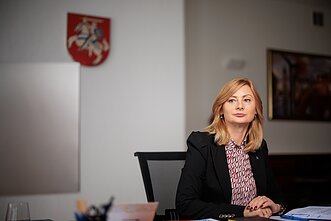
Following the ruling, Jonas and Edmundas once again applied to the court seeking recognition of their partnership. In light of the Constitutional Court’s decision, the court recognised their partnership. However, the Justice Ministry, led by Rita Tamašunienė, began appealing court rulings that ordered the ministry to register partnerships.

According to the ministry, courts have so far recognised 24 partnerships, while another 23 cases are still before the courts. The ministry has already appealed four rulings, seeking to delay the obligation to register partnerships.
The ministry also appealed the ruling recognising the partnership of Jonas and Edmundas. However, according to Sakalauskas, the court dismissed the ministry’s appeal, arguing that there were no grounds for it.
“The Constitutional Court said that until there is a Partnership Law, the courts must resolve this issue, and partnerships can be registered. [...] The state must find a way to register partnerships until the law is adopted,” Sakalauskas, who also represents other same-sex couples in court, told LRT.lt.
He said courts had also dismissed other ministry appeals in cases where he represented same-sex couples. The lawyer stressed that the Constitutional Court’s ruling obliges the state to register partnerships recognised by the courts until legislation is passed.
Sakalauskas and his partner have turned to bailiffs to compel the state to fulfil its obligation to register their partnership. The bailiffs, in turn, have applied to the court seeking a fine against the state for failing to register the partnership.
The lawyer did not rule out supplementing the existing case that he and his partner have brought against Lithuania before the ECHR. In that case, the state’s liability for failing to enforce court decisions could be added.
Sakalauskas stressed that as long as the state refuses to register the court-recognised partnership between him and Edmundas, practical difficulties continue to arise, while the issue of dignity is equally important.
“We have been trying to register our partnership since 2023. [...] It seems the state is prepared to do everything possible not to grant what the courts have already recognised,” he said.
What does a partnership guarantee?
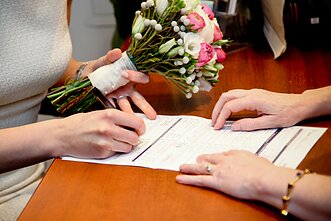
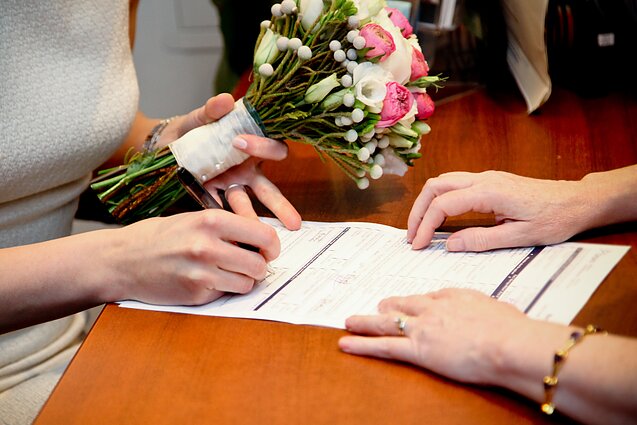
Once a same-sex couple obtains a court ruling recognising their partnership, they acquire certain rights and obligations. For example, partners cannot be compelled to testify against one another, and some public positions require the relationship to be declared.
However, according to lawyer Aivaras Žilvinskas, the court ruling does not grant the substantive rights normally associated with marriage – those must come through official registration of the partnership. Without registration, rights relating to inheritance, shared property and similar matters do not arise.
As a result, if the state refuses to register a partnership, couples would need to go to court separately in each individual case in order to secure those rights.
Žilvinskas believes the Justice Ministry’s decision to appeal court rulings is a political move.
“First of all, the current leadership of the ministry is saying completely different things from the previous minister during the last parliamentary term. [...] The position of the leadership has clearly changed,” he told LRT.lt.
According to him, if there were political will, anyone could adapt the relevant systems within a few days to allow same-sex partnerships to be registered.
“This is a clear unwillingness [to register partnerships],” he said.
Lawyer Donatas Murauskas said the issue of partnerships had become highly politicised, making it attractive for politicians to keep it on the political agenda to appease their voters.
Murauskas also said that by appealing court rulings, the Ministry of Justice was effectively ignoring the Constitutional Court’s judgment.
“It clearly states that until the legislature establishes a procedure for registering partnerships, the right to partnership, including registration, can be exercised through the courts in accordance with the law,” he said.
“In essence, the Constitutional Court ruling and district court decisions are being ignored. The ministry is not trying to resolve the situation but instead is defending itself and arguing that the courts are exceeding their powers. It was the legislature and the government themselves that created this situation, so people are forced to resolve these issues in court,” Murauskas told LRT.lt.
Minister: waiting for parliament’s decision
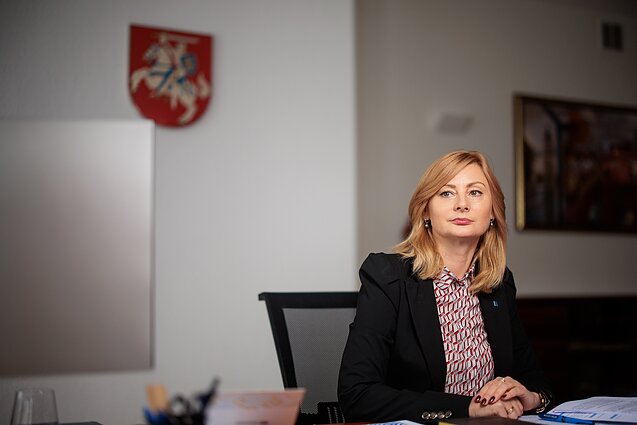
Justice Minister Rita Tamašunienė insisted that the ministry’s appeals do not challenge the existence of partnerships themselves, but rather seek to postpone their registration.
“We are not disputing the fact that partnerships can be recognised, nor are we contesting that. What we are contesting is the part imposing the obligation to register partnerships,” Tamašunienė told LRT.lt.
The minister justified the decision on the grounds that Lithuania has not yet adopted a Partnership Law. Without such legislation, she said, the ministry cannot ensure that partnerships are registered.
“We are waiting for parliament to take this step [on the Partnership Law], and it is certainly worth testing this in a higher court because so far we have only had first-instance rulings. [...] We want to know the opinion and decision of a higher court in cases of this kind,” Tamašunienė said.
The justice minister said that following the Constitutional Court’s ruling, it was clear that partnerships should now be understood more broadly – not only as unions between a man and a woman, but also as same-sex partnerships.
However, she argued that the Constitutional Court’s ruling also obliges parliament to adopt the necessary legislation, meaning institutions cannot register partnerships without a law in place.
“That would be unlawful and an abuse of powers,” Tamašunienė said.

Newsletter
Every Friday morning.