








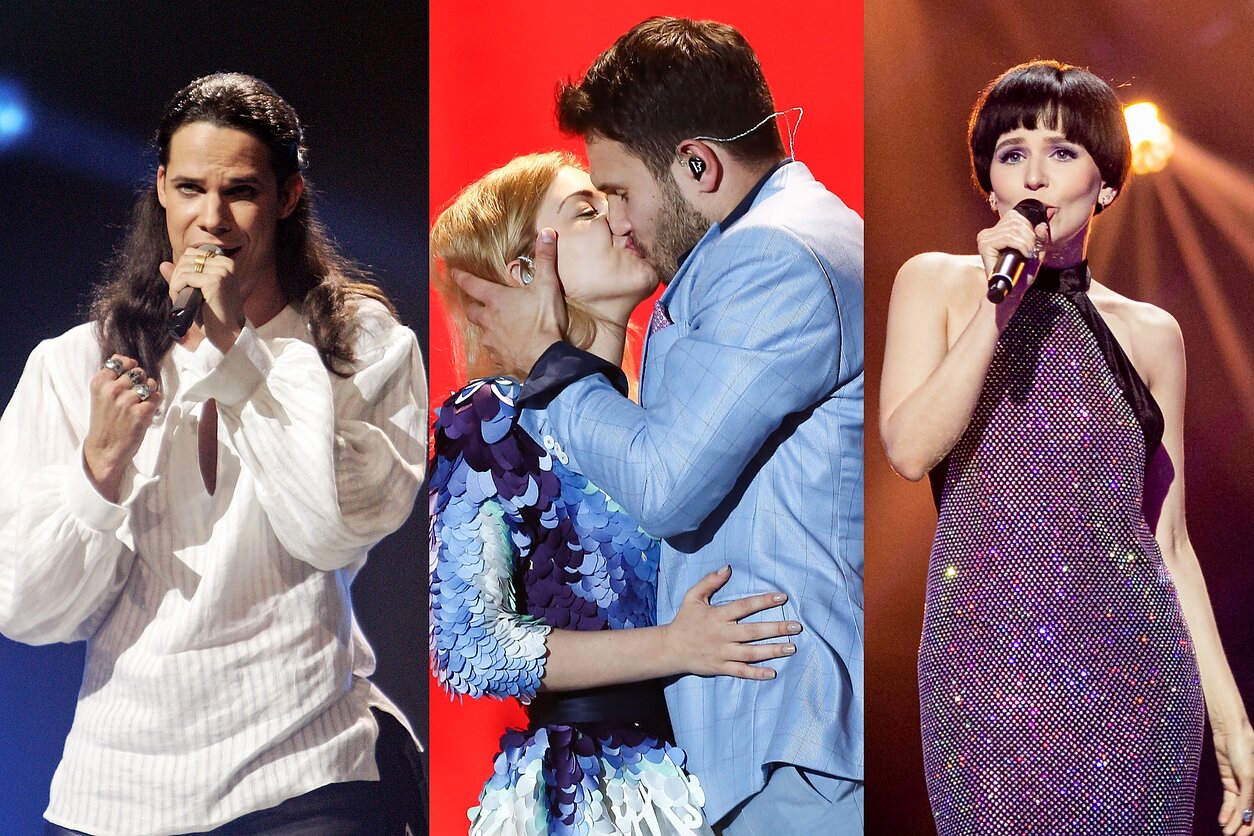
From a memorable beret and a “llama hairstyle” to Monika Linkytė and Vaidas Baumila’s onstage kiss, Lithuania’s Eurovision history has produced no shortage of iconic moments.
As the Eurovision Song Contest marks its 70th edition, Lithuania is preparing for its 26th appearance in the competition. Here is a look back at every Lithuanian act that has taken the Eurovision stage over the past three decades.
1994: Ovidijus Vyšniauskas – Lopšinė mylimai
Lithuania made its Eurovision debut in 1994 with a heartfelt Lithuanian-language ballad, Lopšinė mylimai. The country finished dead-last, earning zero points and placing 25th.
Vilija Grigonytė, coordinator of Lithuania’s first Eurovision delegation, later recalled that the newly independent country had little money for participation and faced patronising questions from foreign journalists unfamiliar with Lithuania.
1999: Aistė Smilgevičiūtė – Strazdas
After a five-year absence, Lithuania returned with the Samogitian folk-inspired song Strazdas. Although the performance finished 20th, many Eurovision fans later praised it as ahead of its time.
The contest itself had also changed significantly by then, with orchestras removed from performances the year before.
2001: Skamp – You Got Style
Lithuania sang in English for the first time in Eurovision history when Skamp performed You Got Style in Copenhagen.
The group broke Lithuania’s poor Eurovision streak and came close to the top 10, finishing 13th.
2002: Aivaras – Happy You
Aivaras’ famous beret became one of the most talked-about fashion choices in Lithuania’s Eurovision history.
The song, however, did not fare well competitively, placing 23rd with 12 points.
2004: Linas and Simona – What’s Happened to Your Love
Eurovision introduced semifinals in 2004, fundamentally changing the competition format.
Linas and Simona represented Lithuania in Istanbul but failed to qualify for the final after finishing 16th in the semifinal.
2005: Laura and the Lovers – Little by Little
Performing in Kyiv, the group earned 17 points and finished 25th in the semifinal.
2006: LT United – We Are the Winners
Still Lithuania’s greatest Eurovision success, LT United became an instant phenomenon.
The supergroup assembled by Andrius Mamontovas finished sixth in Athens with the now-iconic anthem We Are the Winners.
Nearly two decades later, no Lithuanian act has surpassed the result.
2007: 4Fun – Love or Leave
Fronted by Julija Ritčik, 4Fun performed directly in the final thanks to LT United’s previous success, ultimately finishing 21st.
Ritčik later described Eurovision as a once-in-a-lifetime magical adventure.
2008: Jeronimas Milius – Nomads in the Night
Competing in Belgrade, Jeronimas Milius failed to reach the final, placing 16th in the semifinal.
He later admitted he entered Lithuania’s national selection almost as a joke after a friend promised to write him a song.
2009: Sasha Son – Love
Known in Lithuania since childhood, Sasha Son represented the country in Moscow with a multilingual performance combining English and Russian lyrics.
He qualified for the final and finished 23rd.
2010: InCulto – Eastern European Funk
InCulto embraced humour and stereotypes with Eastern European Funk, a cheeky performance aimed at showcasing a playful side of Lithuania.
The group narrowly missed the final, placing 12th in the semifinal.
2011: Evelina Sašenko – C’est ma vie
Performing partly in French, Evelina Sašenko reached the final and finished 19th.
She later described Eurovision as a major adventure and said she was proud Lithuania reached the final unexpectedly.
2012: Donny Montell – Love Is Blind
Donny Montell, performing with a blindfold and acrobatic choreography, became one of Lithuania’s standout Eurovision performers.
He qualified comfortably for the final and finished 14th.
2013: Andrius Pojavis – Something
Andrius Pojavis reached the final in Malmö and placed 22nd.
Years later, he said his original Eurovision bid had been impulsive and motivated mainly by a desire to introduce his music to a wider audience.
2014: Vilija Matačiūnaitė – Attention
Vilija Matačiūnaitė narrowly missed the final in Copenhagen, finishing 11th in the semifinal.
2015: Monika Linkytė and Vaidas Baumila – This Time
Lithuania returned to the Eurovision final with a duet that became unforgettable largely because of the performers’ onstage kiss.
The pair finished 18th in Vienna but left the contest on a wave of optimism.
2016: Donny Montell – I’ve Been Waiting for This Night
Returning to Eurovision after four years, Donny Montell delivered one of Lithuania’s strongest modern-era results.
Fans also could not stop talking about his distinctive hairstyle, quickly nicknamed the “llama hairstyle”.
He finished ninth in Stockholm.
2017: Fusedmarc – Rain of Revolution
The experimental duo failed to qualify for the final, placing 17th in the semifinal.
2018: Ieva Zasimauskaitė – When We’re Old
Ieva Zasimauskaitė charmed audiences in Lisbon with an intimate performance focused on love and connection.
She reached the final and finished 12th.
After returning home, she called Eurovision “the best time” of her life and praised the unity she felt from Lithuanian supporters.
2019: Jurijus Veklenko – Run With the Lions
Jurijus Veklenko narrowly missed the final, though later revelations showed a voting error in Italy may have cost Lithuania a qualification spot.
The singer took the situation calmly, saying the mistake no longer changed the outcome.
2020: The Roop – On Fire
Eurovision was cancelled because of the Covid-19 pandemic, denying Lithuania one of its strongest entries in years a chance to compete.
2021: The Roop – Discoteque
The Roop returned after the pandemic and sparked the “Yellow Wave”, one of Lithuania’s biggest Eurovision phenomena.
Their infectious performance earned eighth place – Lithuania’s second-best result ever.
Despite Covid-19 restrictions and constant testing, the band said Eurovision opened important international doors for Lithuanian music.
2022: Monika Liu – Sentimentai
Monika Liu brought Lithuanian language back to Eurovision and finished 14th in Turin.
She later said she had “caught the Eurovision bug” and would gladly return one day.
Throughout the contest, she was also vocal in supporting Ukraine after Russia’s full-scale invasion earlier that year.
2023: Monika Linkytė – Stay
Another returning performer, Monika Linkytė went to her second Eurovision with Stay, built around the folk-inspired refrain “čiūto tūto”, which audiences across Europe enthusiastically embraced.
She finished 11th in Liverpool and said Lithuanian music was increasingly embracing its uniqueness.
2024: Silvester Belt – Luktelk
Silvester Belt finished 14th in Malmö after an emotionally intense Eurovision journey.
The singer later described the contest as a life-changing experience that strengthened his confidence and reshaped his career.
2025: Katarsis – Tavo akys
The band described every day in Basel as “the best day of life” during their Eurovision experience.
Katarsis finished 16th in the final after performing fifth on the night.
2026: Lion Ceccah – Solo Quiero Más
Lithuania’s latest Eurovision hopeful is preparing for Vienna, where he is set to compete in the first semifinal of the 2026 contest.
Whether Solo Quiero Más reaches the grand final remains to be seen, but Lithuania’s colourful Eurovision story is far from over.